Friday, June 3, 2016

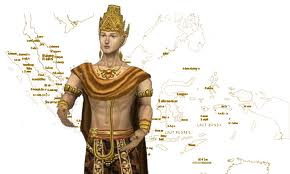
Hayam Wuruk Ruler of Majapahit

Hayam Wuruk

 
Ruler of Majapahit   ayam Wuruk, also called (after 1350) Rajasanagara (born 1334, Java [now in Indonesia]—died 1389, Java) ruler of the Javan Hindu state of Majapahit at the time of its greatest power.
Hayam Wuruk inherited the throne in 1350 at the age of 16, when the great patih(“prime minister”) Gajah Mada was at the height of his career. Under the two leaders, Majapahit extended its power throughout the Indonesian archipelago. Its core area was directly administered by Hayam Wuruk, and the vast outlying territory acknowledged his supremacy, but he exerted little direct control over it.Javanese sea power was supreme, and Hayam Wuruk enjoyed an effective monopoly of trade in the region.
Hayam Wuruk had no heir by his official queen, so he arranged to divide his kingdom between a nephew (married to his daughter by the queen) and his son by a lesser wife. In so doing he broke the unity of the state and allowed local potentates to seize control of portions of Majapahit’s territory. After his death Majapahit rapidly declined and, along with it, the last great manifestation of Hindu civilization in Java.


Dutch East India Company

Dutch East India Company


The United East Indian Company (Dutch: Vereenigde Oost-Indische Compagnie; VOC), referred to by the British as the Dutch East India Company,[2] was originally established as a chartered company in 1602, when the Dutch government granted it a 21-yearmonopoly on Dutch spice trade. It is often considered to have been the first multinational corporation in the world [3] and it was the first company to issue stock.[4] It was a powerful company, possessing quasi-governmental powers, including the ability to wage war, imprison and execute convicts,[5] negotiate treaties, strike its own coins, and establish colonies.[6]
Statistically, the VOC eclipsed all of its rivals in the Asia trade. Between 1602 and 1796 the VOC sent almost a million Europeans to work in the Asia trade on 4,785 ships, and netted for their efforts more than 2.5 million tons of Asian trade goods. By contrast, the rest of Europe combined sent only 882,412 people from 1500 to 1795, and the fleet of the English (later British) East India Company, the VOC's nearest competitor, was a distant second to its total traffic with 2,690 ships and a mere one-fifth the tonnage of goods carried by the VOC. The VOC enjoyed huge profits from its spice monopoly through most of the 17th century.[7]
Having been set up in 1602, to profit from the Malukan spice trade, in 1619 the VOC established a capital in the port city of Jayakartaand changed the city name into Batavia (now Jakarta). Over the next two centuries the Company acquired additional ports as trading bases and safeguarded their interests by taking over surrounding territory.[8] It remained an important trading concern and paid an 18% annual dividend for almost 200 years.[9]
Weighed down by corruption in the late 18th century, the Company went bankrupt and was formally dissolved in 1800,[9] its possessions and the debt being taken over by the government of the Dutch Batavian Republic. The VOC's territories became the Dutch East Indies and were expanded over the course of the 19th century to include the whole of the Indonesian archipelago, and in the 20th century would form the Republic of Indonesia.


During the 16th century, the spice trade was dominated by the Portuguese who used Lisbon as a staple port. Before the Dutch Revolt, Antwerp had played an important role as a distribution centre in northern Europe. However, after 1591 the Portuguese used an international syndicate of the German Fuggers and Welsers, and Spanish and Italian firms, that used Hamburg as its northern staple port to distribute their goods, thereby cutting Dutch merchants out of the trade.
At the same time, the Portuguese trade system was unable to increase supply to satisfy growing demand, in particular the demand for pepper. Demand for spices was relatively inelastic, and therefore each lag in the supply of pepper caused a sharp rise in pepper prices.
In addition, as the Portuguese crown had been united in a personal union with the Spanish crown in 1580, with which the Dutch Republicwas at war, the Portuguese Empire became an appropriate target for Dutch military incursions. These three factors motivated Dutch merchants to enter the intercontinental spice trade themselves. Further, a number of Dutchmen like Jan Huyghen van Linschoten andCornelis de Houtman obtained first hand knowledge of the "secret" Portuguese trade routes and practices, thereby providing opportunity.[10]
The stage was thus set for Houtman's 1595 four-ship exploratory expedition to Banten, the main pepper port of West Java, where they clashed with both the Portuguese and indigenous Indonesians. Houtman's expedition then sailed east along the north coast of Java, losing twelve crew to a Javanese attack at Sidayu and killing a local ruler in Madura. Half the crew were lost before the expedition made it back to the Netherlands the following year, but with enough spices to make a considerable profit.[11]

In 1598, an increasing number of fleets were sent out by competing merchant groups from around the Netherlands. Some fleets were lost, but most were successful, with some voyages producing high profits. In March 1599, a fleet of eight ships under Jacob van Neck was the first Dutch fleet to reach the 'Spice Islands' of Maluku, the source of pepper, cutting out the Javanese middlemen. The ships returned to Europe in 1599 and 1600 and the expedition made a 400 percent profit.[11]
In 1600, the Dutch joined forces with the Muslim Hituese on Ambon Island in an anti-Portuguese alliance, in return for which the Dutch were given the sole right to purchase spices from Hitu.[12] Dutch control of Ambon was achieved when the Portuguese surrendered their fort in Ambon to the Dutch-Hituese alliance. In 1613, the Dutch expelled the Portuguese from their Solor fort, but a subsequent Portuguese attack led to a second change of hands; following this second reoccupation, the Dutch once again captured Solor, in 1636.[12]
East of Solor on the island of Timor, Dutch advances were halted by an autonomous and powerful group of Portuguese Eurasians called the Topasses. They remained in control of the Sandalwood trade and their resistance lasted throughout the 17th and 18th century, causing Portuguese Timor to remain under the Portuguese sphere of control.


THE SULTANATE OF MALACCA


THE SULTANATE OF MALACCA


As a crossroads of trade between the Indian Ocean and East Asia, the Malay Archipelago has consistently been a wealthy, diverse, and politically important region. Islam began to spread in the region through trade not long after the life of Prophet Muhammad (S). For centuries, the people of Southeast Asia slowly began to accept Islam and create Muslim towns and kingdoms.
Perhaps the most important of these kingdoms was the Sultanate of Malacca (Melaka in Malay), which reached its peak in the mid-1400s. As a powerful and influential kingdom, the continued spread of Islam was intricately tied with the rise of the Malacca Sultanate. Unfortunately, however, the Malacca Sultanate would not last, as the newly powerful Portugal conquered the kingdom in 1511 and began a centuries-long period of European domination. 

The Rise of Malacca

One of the most important highways of trade in the pre-modern world was the Strait of Malacca. Bordered on its northern side by the Malay Peninsula and on the southern side by the island of Sumatra, it was the main connection between the Indian Ocean and the South China Sea. As a result, most trade traffic in the region passed through this narrow strait, creating rich trade kingdoms on its shores.

As a powerful and expansive kingdom, the Sultanate of Malacca provided a common culture for the surrounding region that neighboring states attempted to adopt. This unified culture helped spark the spread of Islam throughout the region. Adopting Malay culture and converting to Islam were so connected that it was said when someone became Muslim, they masuk Melayu, meaning they “entered the realm of the Malays”.
Adding to the spread of Islam in the region was the continued presence of Indian and Arab Muslim traders coming from the West and bringing their religion with them and spreading it to the local population. Another factor were the numerous visits by the Chinese Muslim admiral Zheng He (who is known as Cheng Ho in Southeast Asia) who helped spread Islam throughout the Malay Archipelago. It is important to note that as the region slowly made its way into the fold of Islam, there were no forced conversions into the religion.


The Arrival of the Portuguese

The Sultanate of Malacca at its greatest extent in the late 1400s.
In the late 1400s, the Kingdom of Portugal began to search for new trade opportunities on the high seas. Instead of relying on land routes to Asian spice markets (that were dominated by the Venetians), the Portuguese decided to find a sea route to China. The explorer Vasco de Gama managed to sail around the southern tip of Africa in the late 1400s, with the aid of Muslim navigators who were familiar with the Indian Ocean.
With this new discovery in Europe, Portugal quickly became a naval power in the Indian Ocean and attempted to dominate the Asian spice market. After establishing bases in Indian cities such as Goa and Calicut around 1510, the Portuguese looked to the East to expand their trade empire. In 1511, they decided to conquer the important port of Malacca to control the trade with China. At first they attempted to create friendly relationships with the sultan of Malacca, Mahmud Shah and use that as a foothold in the kingdom. However, after being warned by Tamil Muslims who had seen Portuguese atrocities in Goa, Sultan Mahmud refused to allow the Portuguese into the city.


Singhasari kingdom located in east Java between 1222 and 1292


Singhasari was a Javanese Hindu-Buddhist kingdom located in east Java between 1222 and 1292 (today Indonesia). The kingdom succeeded the Kingdom of Kediri as the dominant kingdom in eastern Java. The kingdom's name cognate to Singosaridistrict of Malang Regency, located several kilometres north of Malang city.

Mataram Kingdom java indonesia

Mataram was a Hindu-Buddhist Javanese kingdom based in Central Java between the 8th and 10th centuries AD and was established by king Sanjaya, he was also known as the founder of Sanjaya dynasty. The Sanjaya dynasty reign the kingdom, but then in later period the kingdom was ruled by Isyana Dynasty. Although initially eclipsed in power by the rival SailendraDynasty, by 850 it had become the dominant power in Java and was a serious rival to the hegemonic Srivijaya Empire.

Origin and formation

The early account of Mataram kingdom is mentioned in Canggal inscription, dated 732, discovered in Canggal village, southwest from the town of Magelang. This inscription was written in Pallava letters and in Sanskrit, and tell about the erection of a lingga (symbol of Shiva) on the hill in the Kunjarakunja area. This area is located at a noble island called Yawadwipa (Java) which blessed with abundance of rice and gold. This inscription tells that Yawadwipa was reigned by kingSanna, which his long period of reign was marked with wisdom and virtue. After king Sanna died the kingdom fell into disunity. Confused because lost of ruler and patron, Sanjaya ascend to throne, he was the son of Sannaha (sister of Sanna). He was king that mastered holy scriptures, martial art, and also military prowess. He conquered neighboring area around his kingdom, his wise reign blessed his land with peace and prosperity for all his subjects [1].
King Sanna and Sanjaya also known in Carita Parahyangan, a book from later period which mainly tell the history of Pasundan (Sunda Kingdom). This book mentioned that Sanna was defeated by Purbasora, king of Galuh, then he retreated to mount Merapi. Later Sanna's successor Sanjaya reclaim Sanna's kingdom and ruled West Java, Central Java, East Java, and Bali. He also involved in battle with Malayu and Keling (against their king Sang Srivijaya). In main theme of Carita Parahyangan is corresponds to Canggal inscription.
Earliest evidence of a currencysystem in Java. Javanese goldmas or tahil ingot, circa 9th century.
From the time of its founding in early 8th century until 928, the kingdom was ruled by the Sanjaya Dynasty. The first king of Mataram was Sanjaya, who left the written records on Canggal inscriptions. However around mid 8th century, Sailendra dynasty emerged in Central Java and challenged Sanjaya dynasty domination on the region. According to Kalasan inscription dated 778 AD, pranagari script written in sanskrit, the Kalasan temple was erected by the will of Guru Sang Raja Sailendravamçatilaka (the Jewel of Sailendra family) that succeed to persuade Maharaja Tejapurnapana Panangkaran(Sanjaya's successor) to construct a holy building for the goddess (boddhisattvadevi) Tara and also build a vihara(monastery) for Buddhist monks from Sailendra family's realm. Panangkaran awarded the Kalaça village to sangha (Buddhist monastic community).[2].
The received version holds that the Sailendra dynasty existed next to the Sanjaya dynasty in Central Java, and much of the period was characterized by peaceful co-existence and cooperation. A theory proposed that Sailendra is a branch of Sanjaya family that convert to Buddhism. Another theory holds that Sailendra with their strong connections to Srivijaya managed to gain control on Central Java and imposing overlordship on the Rakai (local Javanese lords) including the Sanjayas, thus make the kings of Mataram Sanjaya as their vassal.
Little is known about the kingdom due to the dominance of the Sailendra which during this period construct BorobudurBuddhist monument. Samaratungga, the monarch of Sailendra, tried to secure Sailendra's position in Java, cementing alliance with Sanjayas by arranging the marriage of his daughter Pramodhawardhani with Rakai Pikatan.
Around the middle of the 9th century relations between Sanjaya and Sailendra had deteriorated. In 852 the Sanjaya ruler Pikatan had defeated Balaputra, the offspring of the Sailendra monarch Samaratunga, and princess Tara. This ended the Sailendra presence in Java and Balaputra retreated to the Srivijaya in Sumatra, where he became the paramount ruler.[

Shailendra dynasty

Shailendra dynasty


The Shailendra dynasty (IAST: Śailēndra derived from Sanskrit combined words Śaila andIndra, meaning "King of the Mountain",[1] also spelled Sailendra, Syailendra or Selendra) was the name of a notable Indonesian dynasty that emerged in 8th century Java whose reign marked a cultural renaissance in the region. The Shailendras were active promoters ofMahayana Buddhism and covered the Kedu Plain of Central Java with Buddhist monuments, one of which is the colossal stupa of Borobudur, now a UNESCO World Heritage Site.[2][3][4]
The Shailendras are considered to be a thalassocracy and ruled maritime Southeast Asia, however they also relied on agriculture pursuits through intensive rice cultivation on the Kedu Plain of Central Java. The dynasty appeared to be the ruling family of both the Medang Kingdom of Central Java for some period and Srivijaya in Sumatra.
The inscriptions created by Shailendras uses three languages; Old Malay, Old Javanese andSanskrit, written either in the Kawi alphabet or pre-Nāgarī script. The use of Old Malay has sparked the speculation of a Sumatran origin or Srivijayan connection of this family; on the other hand, the use of Old Javanese suggests their firm political establishment on Java. The use of Sanskrit usually signifies the official nature and religious significance of the event written on the inscription.

37 Majapahit empire


Majapahit empire


Historical kingdom, Indonesia    Majapahit empire, the last Indianized kingdom in Indonesia; based in eastern Java, it existed between the 13th and 16th centuries. The founder of the empire was Vijaya, a prince of Singhasāri, who escaped when Jayakatwang, the ruler of Kaḍiri, seized the palace. In 1292 Mongol troops came to Java to avenge an insult to the emperor of China, Kublai Khan, by Kertanagara, the king of Singhasāri, who had been replaced by Jayakatwang. Vijaya collaborated with Mongol troops in defeating Jayakatwang; Vijaya then turned against the Mongols and expelled them from Java.
Under his rule the new kingdom, Majapahit, successfully controlled Bali, Madura, Malayu, and Tanjungpura. The power of Majapahit reached its height in the mid-14th century under the leadership of King Hayam Wuruk and his prime minister, Gajah Mada. Some scholars have argued that the territories of Majapahit covered present-day Indonesia and part of Malaysia, but others maintain that its territory was confined to eastern Java and Bali. Nonetheless, Majapahit became a significant power in the region, maintaining regular relations with China, Champa, Cambodia, Annam, and Siam (Thailand). The golden era of Majapahit was short-lived; the empire began to decline after the death of Gajah Mada in 1364, and it was further weakened after the death of Hayam Wuruk in 1389. The spread of Islām and the rise of the Islāmic states along the northern coast of Java eventually brought the Majapahit era to an end in the late 15th or early 16th century.